


 23 / 36

spring / summer 2017 |
aspects of land
|
23
For some, politics is a concern, but for others it is
an opportunity to embrace and find positivity out of
dramatic change, says Alex. “Looking forward, there is
undoubtedly political uncertainty, but land, farms and
estates have a broad appeal for numerous buyer types as a
tangible asset.Therefore, it is highly likely that land will
remain in demand for most, if not all areas.”
With a limited supply of land on the market – around
150,000-200,000 acres in Britain annually – it is unlikely
that land values will fall far. Mainly driven by retirement,
land supply in Britain went up 2 per cent last year:
0 per cent in England and 2 per cent in Scotland. “Unless
volumes increase by more than 50 per cent from these
levels, land values are unlikely to be materially affected
by supply,” says Charles Dudgeon of Savills Farms and
Estates, Scotland.
Farm incomes are at the mercy of commodity prices
and with subsidies expected to fall, estates that do not
rely solely on agriculture will be more appealing, says
Charles. Demand for land in Scotland will come from
farmers looking to increase in scale or return to a close-
knit farming community. “The drive in demand is for
scale at good value.The price of Scottish land used to
be at a 10-15 per cent discount to England, however
this is now as much as 50 per cent, drawing in English
buyers,” he says.
In Scotland, arable and hill ground will be the most
attractive to investors as arable land is in such short
supply and hill ground allows for extensive farming
and is also supported by forestry, amenity and sporting
opportunities, explains Charles. Hill ground is also
expected to receive the best subsidy support post-Brexit
in Scotland.The uplands are also popular sporting areas,
which appeals to offshore money especially with the
currency changes post-Brexit.
In 2015 and 2016 around 50 per cent of sporting
estate buyers were British and 50 per cent were offshore,
suggesting there will be investment irrespective of the
political climate.
n
Alex Lawson, London, 020 7409 8882, alawson@
savills.comn
Charles Dudgeon, Edinburgh, 0131 247 3702,
cdudgeon@savills.comn
Ian Bailey, London, 020 7299
3099,
ibailey@savills.comSOUTH EAST ENGLAND
Total area (acres)
3.5m
1 year % change
-3.9%
10 year % change
210%
North of
England
£33.6
bn
Scotland
£30.0
bn
Wales
£18.0
bn
West Midlands
£14.7
bn
South West
of England
£23.5
bn
South East
of England
£25.7
bn
East of England
£21.9
bn
East Midlands
£18.3
bn
SCOTLAND
Total area (acres)
13.8m
1 year % change
-3.0%
10 year % change
89%
NORTH OF ENGLAND
Total area (acres)
6.4m
1 year % change
-2.9%
10 year % change
134%
EAST MIDLANDS
Total area (acres)
2.8m
1 year % change
-1.1%
10 year % change
188%
WALES
Total area (acres)
4.1m
1 year % change
-0.9%
10 year % change
131%
WEST MIDLANDS
Total area (acres)
2.2m
1 year % change
-0.9%
10 year % change
215%
EAST OF ENGLAND
Total area (acres)
3.2m
1 year % change
-6.2%
10 year % change
177%
SOUTH WEST ENGLAND
Total area (acres)
3.9m
1 year % change
-2.5%
10 year % change
153%
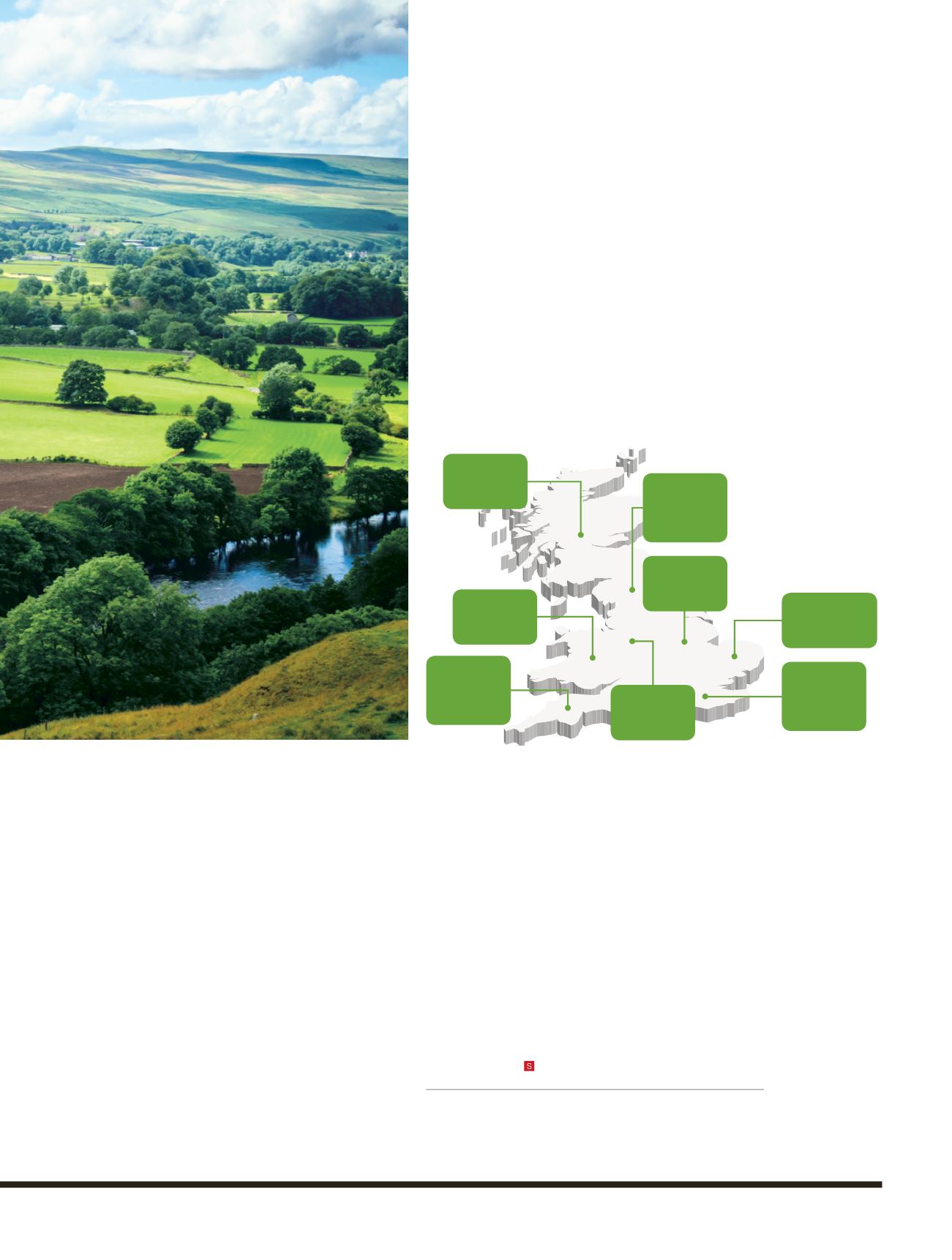
BRITAIN BY VALUE
Savills inaugural Valuing Rural
Britain analysis offers a new
dimension to the farmland markets.
It puts a value on all of the UK’s
farmland and woodland taking
into account all grades of land
and applying a discount for vacant
possession of tenanted farmland.
The combined value of Britain’s
39.8 million acres is £185.7 billion,
which is the equivalent to 3 per
cent of the total value of the UK’s
housing stock. This is how it breaks
down by region.
“LAND, FARMS
AND ESTATES
HAVE A BROAD
APPEAL FOR
NUMEROUS
BUYER TYPES AS
A TANGIBLE ASSET.
THEREFORE, IT
IS HIGHLY LIKELY
THAT LAND WILL
REMAIN IN
DEMAND FOR
SOME, IF NOT
ALL AREAS”
SHUTTERSTOCK