


 28 / 36

28
|
aspects of land
| spring / summer 2017
EXPERT OPINION
SUBSIDY FREE
STUART GRAY
Landowner and dairy
farmer in Scotland
“Seven years ago I
decided to farm without
subsidies – I just got
fed up with all the
paperwork. I made up
my mind to stop and
that was it. I always
thought that we would
eventually lose subsidies,
so it just made sense.
Today we farm a
grass-based New
Zealand system with
400 dairy cows. Farming
without subsidies makes
you tighten everything
up. You’ve got to forward
plan more efficiently but
I have no
regrets.Wecan farm as we want
to
farm.We’ve had no
problems and we’re
completely happy with
how it has gone.
I think it would be
a great thing if the
government did scrap
subsidies, but it is
obviously going to try
and keep them going for
a while yet.
It’s a bad system
because it doesn’t help
young farmers get started
and the farmers who
are depending on them
are probably better off
getting out of farming.
If there are no
subsidies, people will be
forced to up their game
and they will be better
farmers because of it.”
THE BANKER
OLIVER M
C
ENTYRE
National Agricultural
Strategy Director, Barclays
“If subsidy support
is withdrawn, the
marketing of British
produce would need to
be significantly scaled
up to promote brand
and country of origin
loyalty with the British
consumer. For that brand
loyalty to fall into place,
UK produce would have
to be price competitive
with produce from
around the world, as
many consumers buy on
price rather than origin.
“Therefore, UK
farming would need
to move to even more
highly efficient, high
output production to
provide for the everyday
market, as while there
is always going to be a
THE RURAL GUARDIAN
PATRICK BEGG,
Rural Enterprises
Director, National Trust
“Farming and the
environment – so
inextricably linked –
look vulnerable to a
Brexit
shock.Weneed
to ensure that public
money supports farming
that delivers public
goods – such as quality
food, more wildlife and
beautiful landscapes.
“Direct payments
have kept many
businesses afloat. Dig
deeper, however, and
you find that they
have also encouraged
dependence and masked
fundamental weaknesses
in farm business models.
Agri-environment
payments have slowed
wildlife declines, but
biodiversity and soil
quality are still falling.
“Coupled with a harsh
trading environment
outside the EU, we
could see a race to the
bottom for UK farming.
Welfare standards and
environmental protection
could be sacrificed in the
struggle to compete on
the world stage.
“Neither the public
nor farmers want this
future.Weall want
sustainably produced
food, more wildlife and
beautiful landscapes.
Farming can provide
water management to
ensure less devastating
floods, carbon storage
and it can help improve
the nation’s health – and
it already does this.
“Farmers should be
supported financially for
providing these public
goods, alongside high
quality food for which
the market will pay.
“But it would be naive
to expect the government
alone to pick up the
tab.Weneed new ideas.
With think tank Green
Alliance and other
landowners, we’re looking
at how to create markets
for these public goods,
which can sit alongside
food production at the
heart of farm businesses
post Brexit.”
market for high quality
produce, the breadth of
that market is limited.
“There also needs to
be a clear differential
between subsidised food
production and payments
for environmental
management – in reality
this is something which
needs to take more of
a visible profile anyway
within the understanding
of UK consumers.
“A loss of subsidy
would drive a need for
many to achieve even
higher levels of efficient
production, without
compromising welfare
standards and quality
of product, to drive
profitability.While
those in geographically
challenged areas
would need to look
to environmental
management payments
to add income to
their business.
“Whatever the future
of farm subsidies, a
business will need to
have long-term viability
to give a bank confidence
to offer long-term
financial support.”
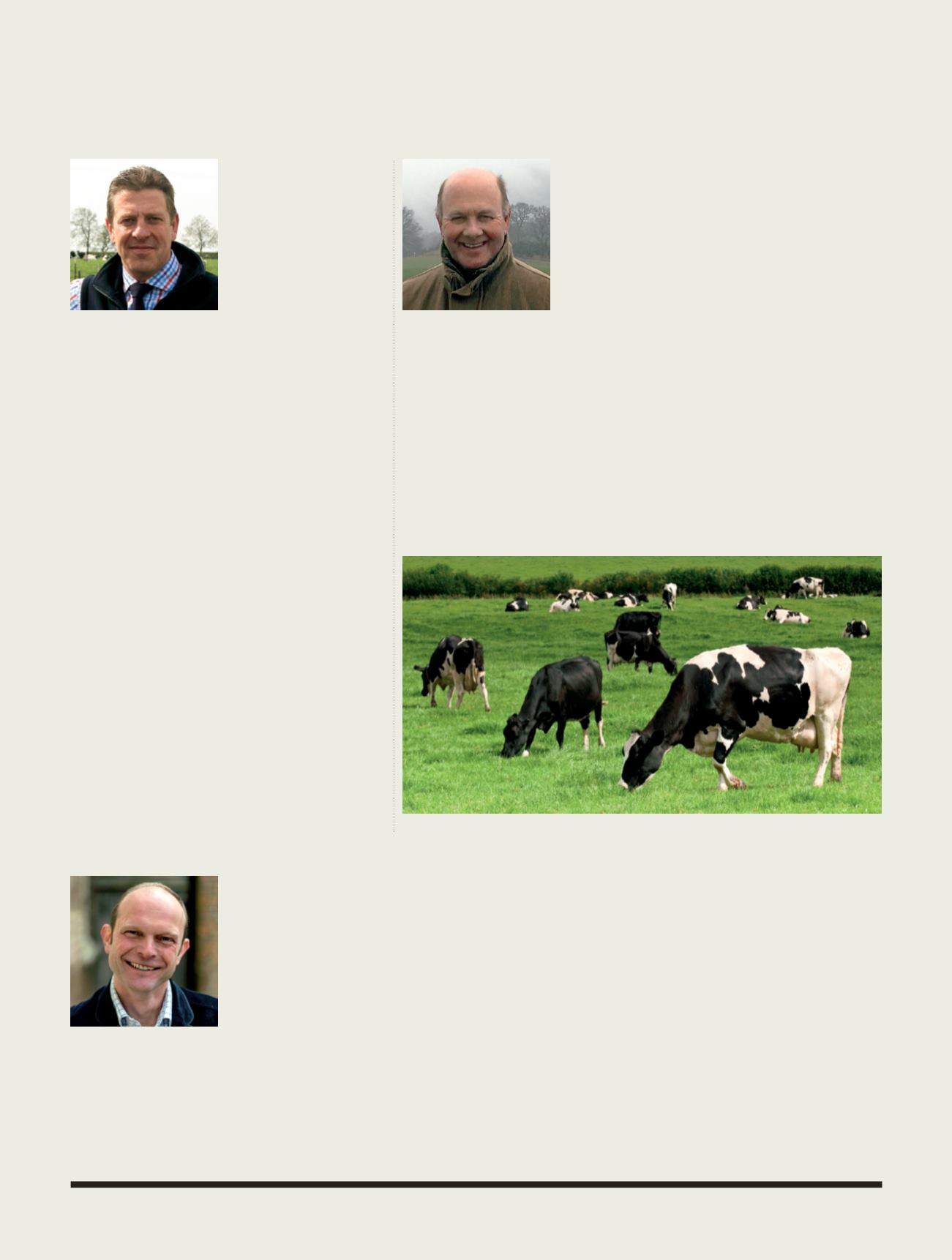
Dairy farmers typically earn 20 per cent of their income through sudsidy
“FARMING WITHOUT
SUBSIDIES MAKES YOU
TIGHTEN EVERYTHING UP.
YOU’VE GOT TO FORWARD
PLAN MORE EFFICIENTLY
BUT I HAVE NO REGRETS”
SHUTTERSTOCK