


 21 / 36

spring / summer 2017 |
aspects of land
|
21
MOCKFORD,
PARKMINSTER,
WEST SUSSEX
Mockford in West Sussex
was built in the 16th
century as a timber-framed,
Sussex Wealden hall house.
Over time, it was converted
and adapted into a pair of
farm cottages, which in
recent years had fallen into
a very dilapidated state.
Owned by St Hugh’s
Charterhouse, a Carthusian
order of monks, the
property is Grade II listed
and part of an estate
managed by Savills.
“We could see the
historic and architectural
merit of the building, and
recommended that it was
time to carry out a major
restoration and up-grading,”
says Terry Adsett of Savills
Rural Building Surveying.
“We felt that it would be
more profitable to restore
the building as one house
and let it out as one four-
bedroom property rather
than two smaller cottages.”
The approach by the
team at Savills, alongside
local building contractors,
was to pare back layers of
decoration and alterations
to reveal the original
timber framing, including
medieval rafters and a
castellated dais beam
between the entrance
lobby and the kitchen.
“Piecemeal and ad-hoc
repairs had been carried
out over the years but in
many cases these were
unsympathetic,” explains
Terry. “Through careful
planning, we were able
to renovate the building
to modern day standards
while retaining all the
historic roof and timber
frame in place and inserting
a steel frame and metal
brackets where essential.”
These efforts paid off and
the building won the small-
scale residential award in
the Sussex Heritage Trust
Awards in 2016.
n
Terry Adsett, Petworth,
01798 345 988,
tadsett@savills.comSUDBURY COURT-
YARD, SUDBURY,
DERBYSHIRE
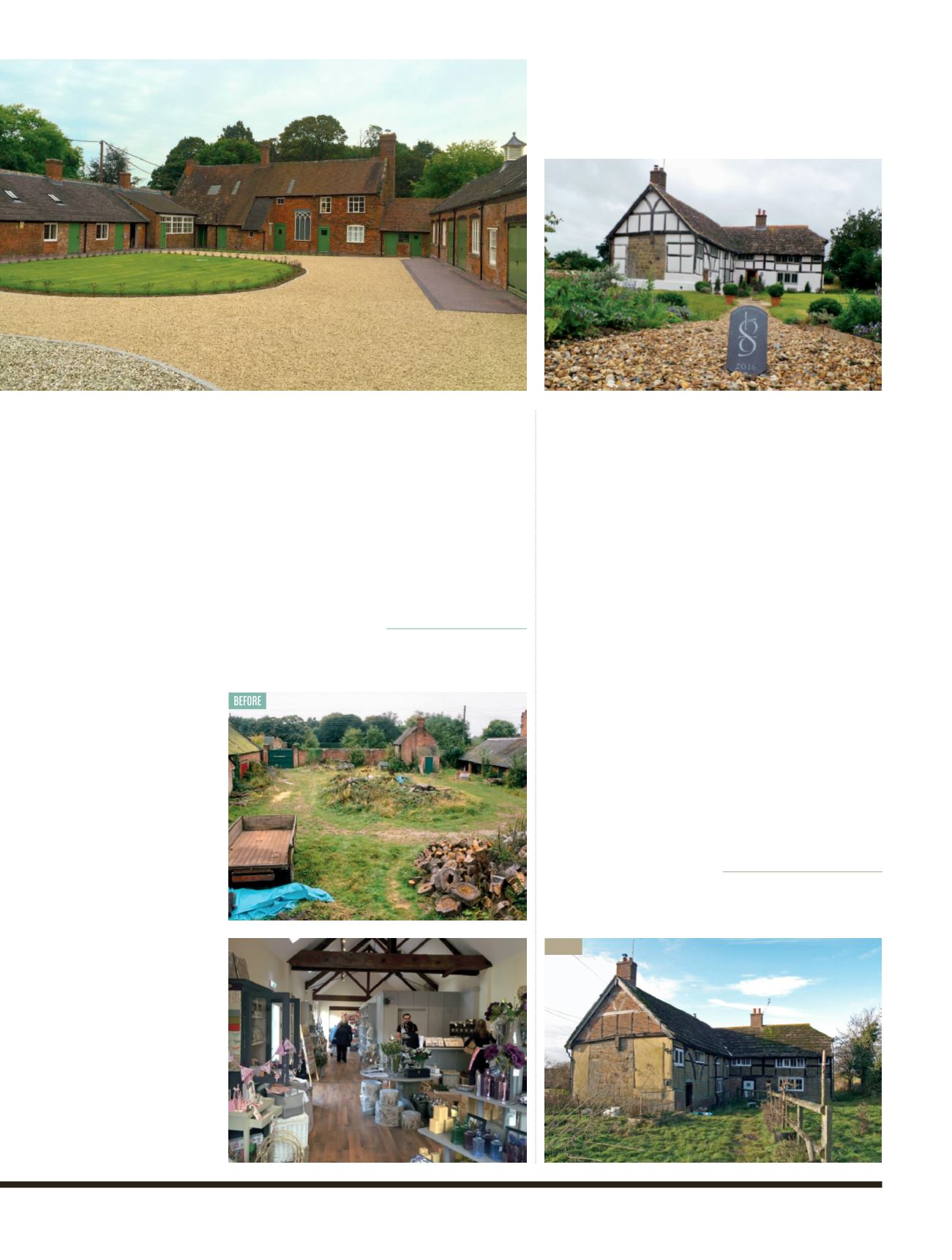
The Sudbury Estate in
Derbyshire had an old
courtyard of Grade II
listed redundant and
under-utilised traditional
estate buildings that
it wanted to bring into
productive use. It applied
for planning and listed
building consent to
convert the courtyard
into a collection of
retail spaces for
local businesses that
would complement
the village’s existing
butcher, pub, post office
and general shop.
“The courtyard is in
the heart of the village,
adjacent to the National
Trust-owned Sudbury
Hall and the Museum
of Childhood,” explains
Chris Batterby of
Savills Rural Building
Surveying. “Our client
wanted to ensure that
the results benefited
the village as well as
visitors to the estate
and wider area.”
“One of the main
challenges the
project faced was
the positioning of
four air-source heat
pumps to serve the
proposed renewable
heating system that
lay within sight of the
Grade I listed Sudbury
Hall,” says Chris who
project managed the
conversions. “In order
to overcome this, we
re-positioned them
25 metres away from
the plant room within
an area of established
landscape and
surrounded by a raised
landscaped bund.”
Traditional doors
and windows meant
that it was difficult to
achieve the level of air
tightness required by
building regulations
without compromising
the period features.
However, with well
designed and expertly
crafted external joinery,
doubled-glazed screens
behind the original doors
and extra insulation in
the walls, floors and
ceilings, most of the
heat losses were off-set.
The courtyard is now
a thriving collection
of shops that are all
let and more units are
planned for conversion
in the near future.
www.sudburyestate.comn
Chris Batterby,
Lichfield, 01543 266 406,
cbatterby@savills.comBEFORE