


 16 / 36

16
|
aspects of land
| spring / summer 2017
DIVERSIFICATION
“When we meet an owner and discuss what might
work for the estate, the first step is to understand their
aspirations and how these might be translated into
commercial opportunities. A lot of the time, location
plays a major role in what will work best,” says Simon.
“Depending on the enterprise, you can see a return on
investment in a relatively short space of time.There can
also be tax benefits as running an enterprise such as a café
and farm shop, that is classed as a trading activity, opens
up eligibility to business property relief when it comes to
inheritance tax.”
Choosing the right diversification is crucial and often
the network of other estate owners can provide informal
help and advice as a starting point.
“In recent years, there has been a move by estates
to look much more seriously at the opportunities and
not just from holiday cottages or camping,” says James
Higham of Savills Leisure and Trade Related Property.
“We’re working with a Scottish estate at the moment that
is developing a yoga centre and retreat; it is a good fit for
them as there is a personal interest in the activity, plus it
is in an area that has traditionally attracted creative types
such as artists and musicians,” says James.
Finding that right fit from a personal perspective is
another key element to choosing the right enterprise. Not
everyone is a “people person”, says James.
“Being honest about your strengths and weaknesses is
important – if you don’t enjoy being hands on and engaging
with people day to day, then offering something like
holiday cottages won’t work. It may be that other members
of the family, or team, are better suited to that, or it may
be better to outsource the management of the enterprise.”
James also advises being clear about what role the new
enterprise will play. For example, if the aim is to generate
income that will help to maintain an existing asset such
as a historic house, this can be influential in persuading
planners to green light the project.
“Business plans that look five, 10 or even 15 years
ahead are crucial, as is making sure the younger
generation is on board with the plan,” says James.
The influence of the next generation of estate owners is
not to be underestimated – Simon says there is a tangible
trend for more contemporary leisure enterprises as
younger owners take the reins.
“Where once it was about opening the house and
gardens up to the public, now owners are working harder
to draw in a whole new demographic of visitors,” says
Simon. “The wedding market remains very strong, but
there has been a move to offer something more informal
and imaginative than just the stately home as a venue.
There are children’s playgrounds, museums, festivals
and seasonal attractions such as Easter egg hunts and
Christmas markets. ”
Inevitably, the cost of a new enterprise is a significant
factor and it varies hugely. At one end of the scale,
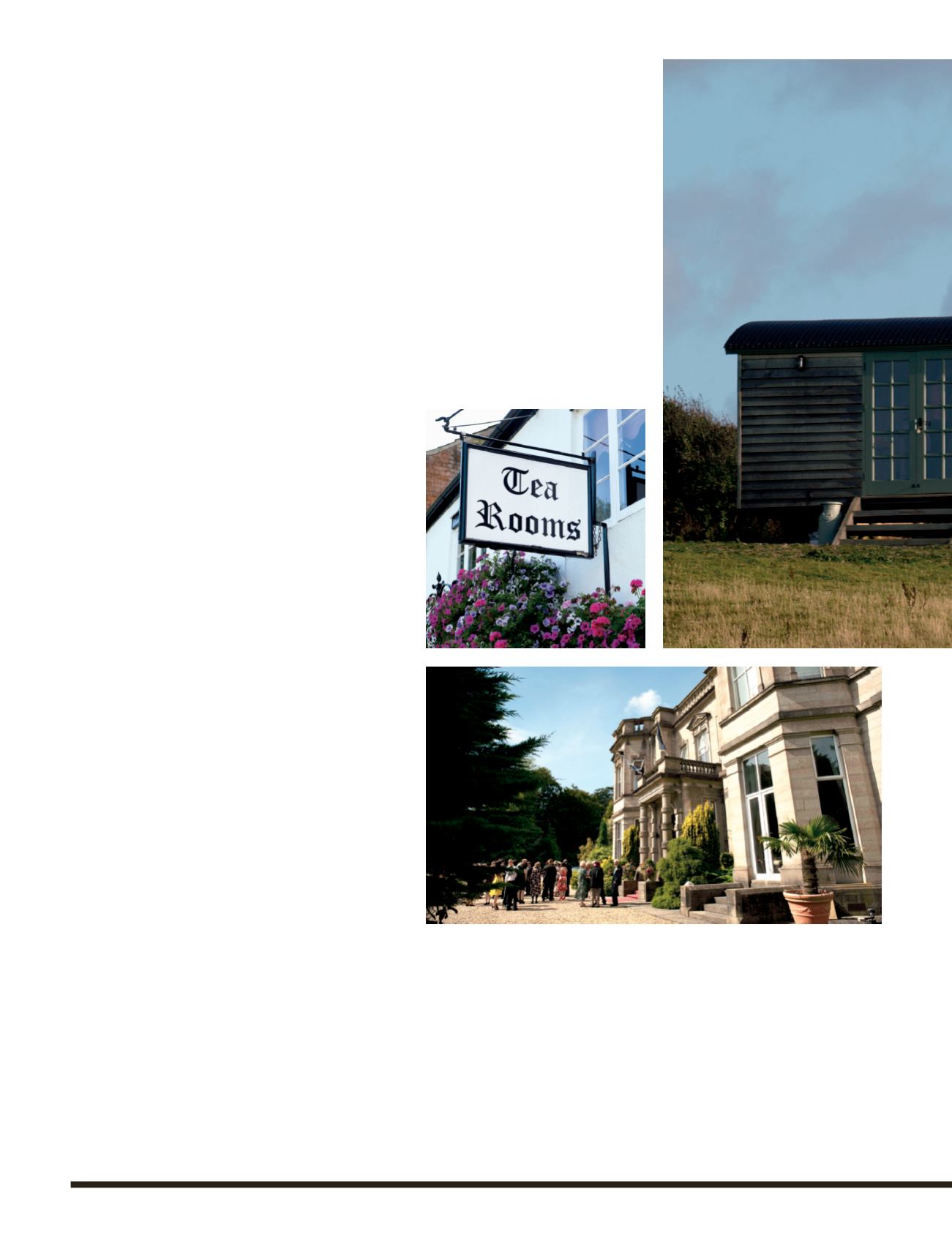
Owners are
branching
out from the
traditional course
of opening
the house
to the public
by providing
glamping, cafés
and wedding
venues
HOW TO DIVERSIFY
SUCCESSFULLY
n
Know your aims and
aspirations in advance.
n
Choose something that
you are interested in and that
is appropriate to the location.
n
Prepare a long-term
business plan.
n
Make sure future
generations share your
enthusiasm for the project.
n
Do your research before
you start work.
provision of land for an external promoter to use as
a festival or event location usually requires no capital
investment and can provide a very good return.
“Holiday lets are still a very popular diversification
and will generate a good return if the properties are in
the right location and finished to a high standard,” says
Simon. “Converting a cottage for use as a holiday let
usually means costs of £40-50,000 but, done well, it
will quickly see 75-80 per cent occupancy rates.”
A more major project, such as turning the estate into
a wedding venue, could require a seven-figure capital
investment for a complete renovation of the main house
KEITH MORRIS / ALAMY
NIK TAYLOR / ALAMY, SHUTTERSTOCK